





Health & Education
We all want the best care possible for our horses. The Heath & Education section covers both Learning Institutions, Organizations as well as many sources for equine assistance including Veterinarians and Farriers.
For those who want a to formally study horses, the Education section includes College Riding, Equine Studies, and Veterinary Schools. Learn about the wide variety of horses in the Horse Breeds section. Supplements and Treatments Therapy are also included in the section.
Everyone can learn from Fine Art and there are some specialty Museums that might surprise you.
Horses as a therapy partner enrich the lives of the disabled. These facilities are listed in our Therapeutic Riding section. To help children and young adults build confidence and grow emotionally, please see the resources available on the Youth Outreach page.
Looking for a place to keep your horse? You can find it in the Horse Boarding section. Traveling? Find a Shipping company or Horse Sitting service if your horse is staying home!
Want to stay up to date with the latest training clinics or professional conferences? Take a look at our Calendar of Events for Health & Education for the dates and locations of upcoming events.
Do we need to add more? Please use the useful feedback link and let us know!
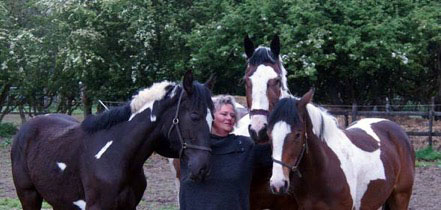
by Patricia N. Saffran
Heather Kitching breeds stunning large spotted Thoroughbreds, at her Angrove Stud, Great Ayton, Yorkshire, UK. She began her breeding program in 2006, after a careful study of horse genetics. She says, “Sabino 1 (SB1) white patterning did not enter into our breeding program and SB1 is not a color variant for Thoroughbreds.”
Ms. Kitching explains, “I did not introduce Quarter Horses into our breeding program. We used horses who were tobiano [white on the legs and large clean white spots on the body] but that carried a high percentage of Thoroughbred. They were eventers carrying Irish blood. Our horses are over 92% Thoroughbred now, and the next generation will take them to 95.6% Thoroughbred. Although Sabino 1 does not appear in the Thoroughbred, there are many variants of the W gene [white patterning] in the Thoroughbred that I know of, at least two.”
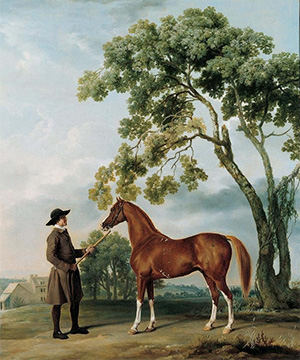
by Patricia N. Saffran
“Do you see that Thoroughbred in the pasture over there with the splotchy paint colors and white socks above the knees? He has to have Quarter Horse in him, but don’t say I told you so.
I could get in a lot of trouble with the Jockey Club if anyone found out I was saying Thoroughbreds aren’t what they’re supposed to be,” so says an anonymous source on a visit to a New York State Thoroughbred farm. Sure enough, the horse in question had a beautiful Thoroughbred conformation but was quite colorful.
Do Thoroughbreds have Quarter Horse in them and is that responsible for the occasional high colors and socks above the knees? What are the genetics responsible for the high colors in both breeds so that one pattern can resemble the other, or more importantly, what are the latest genetic findings?
The Thoroughbred is often described as a purebred horse but this is not the case according to Franco Varola. He modified a French mathematical theory, Dosage Index, for racehorse performance with a points rating to distinguish short distance sprinters against the stamina needed for long distance runners.
In Typology of the Racehorse, J.A. Allen, 1974, Varola writes, “The Thoroughbred in the present-day meaning of the word is neither a pure nor an impure animal, but much more simply a hybrid, obtained by crossing different strains for racing purposes, and by keeping these strains isolated from the remainder of the species of the genus Equus within a register known as the General Stud Book [UK, first published in 1793].”
Varola finds the influence of the founding fathers of the breed in the 18th century too nebulous and prefers to trace them through more recent descendants, who have been bred to each other in what he calls a kaleidoscope of changing parts that remain the same. Regardless, he still refers to Thoroughbreds as hybrids. The notion of hybrid also applies to Quarter Horses.
Read more: In Hot Pursuit of Thoroughbred and Quarter Horse High Colors
- Spring Grass Safety - A Review
- Must-Haves for Your Equine First-Aid Kit
- Tracking Down the Tobiano Legend
- Orphan Foals: Success is Possible
- Health, Horses, Healing and Hippocrates
- Broodmare Nutrition During Late Gestation
- ‘Anonymous Horses’: Kill Pen Rescues Come With Serious Health Risks
- Introducing the Rare, Colorful and Beautiful Knabstrupper Breed
- Horse Speak: The Equine-Human Translation Guide
- A Breed from the Appalachian Mountains, Introducing the Mountain Pleasure Horse!
- UHC Gelding Clinics 2017
- Walkaloosa Horses and Their Colorful Coats
- The Morgan Horse: America's First Breed
- Big, Black and Beautiful! The History of the Majestic Friesian Horse
- Unwanted Horse Coalition Releases New Operation Gelding Program Policies for 2017
- Introducing the Trakehner: The Oldest of Warmblood Breeds
- Profiling the American Quarter Horse, A Very Versatile Breed
- Small but Mighty! See the Benefits of Feed Balancers
- Is My Hay Green Enough?
- Britain's Oldest Horse Breed in Battle for Survival