





Health & Education
We all want the best care possible for our horses. The Heath & Education section covers both Learning Institutions, Organizations as well as many sources for equine assistance including Veterinarians and Farriers.
For those who want a to formally study horses, the Education section includes College Riding, Equine Studies, and Veterinary Schools. Learn about the wide variety of horses in the Horse Breeds section. Supplements and Treatments Therapy are also included in the section.
Everyone can learn from Fine Art and there are some specialty Museums that might surprise you.
Horses as a therapy partner enrich the lives of the disabled. These facilities are listed in our Therapeutic Riding section. To help children and young adults build confidence and grow emotionally, please see the resources available on the Youth Outreach page.
Looking for a place to keep your horse? You can find it in the Horse Boarding section. Traveling? Find a Shipping company or Horse Sitting service if your horse is staying home!
Want to stay up to date with the latest training clinics or professional conferences? Take a look at our Calendar of Events for Health & Education for the dates and locations of upcoming events.
Do we need to add more? Please use the useful feedback link and let us know!
by Juliet M. Getty, Ph.D.
As if aging isn’t hard enough! Creaky joints, sagging backs, loose teeth, increased infections, poor digestion, and embarrassing gassiness -- just a few of the problems associated with getting older (for your horse, not you!).
But what was once a given in youth, now turns into a deficiency – vitamin C must now be added to the diet. You see, young horses are able to produce all the vitamin C they need for every-day health. This is why you typically do not see it added to commercially fortified horse feeds.
But as horses get up in years, they are less able to manufacture vitamin C. Decreased liver function is the main reason, but it can also be due to a decline in hindgut microflora and an increased propensity for pituitary dysfunction.
Why is vitamin C so important?
It prevents oxidative damage to your horse’s tissues and organs. In other words, it is an antioxidant. Antioxidants donate electrons to highly volatile, damaging molecules known as free radicals. Free radical production is accelerated during any type of physical or mental stress, muscle and joint inflammation, allergies, illness/injury, or exposure to toxins and pollutants.
But once free radicals receive their missing electron from vitamin C, they are neutralized – calmed down – and are no longer harmful.
by Doug Thal DVM DABVP
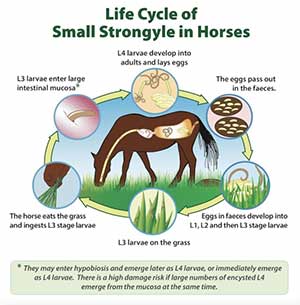
Equine parasites are becoming resistant to our de-worming compounds. This blog post addresses why this is a HUGE CONCERN not only for your horse, but for the entire horse industry.
Recently I had to euthanize a world-class 4-year-old Quarter Horse mare, a real tragedy. She had badly damaged intestines, and after 2 colic operations, we decided to put her down. Her problems were partly brought on by a severe infestation of large roundworms (Ascarids). This type of parasite is common in young horses but VERY rare in adults. My first thought when I saw all the large adult parasites at surgery was “Why isn’t this mare being de-wormed?” When I asked the trainer about her parasite control program though, she said she had been wormed every 5 weeks!
While this mare probably had a very rare “immune tolerance” to these parasites, what was most alarming was that the parasites were able to survive in the face of repeated dousing in de-worming chemicals. These worms were resistant to the de-wormers being used!
- Laminitis: A Year-Round Concern
- Quality Care for Tendons and Ligaments
- Feeding Flaxseeds: Do you have all the facts?
- 5 Red Flags You Should Not Ignore When Horse Shopping (And How to Address Them)
- The Secret to Healthy Horses? Keep it Simple!
- Horse Health: Equine Influenza and How to Minimize Your Risk
- Managing Horses in Hot Weather
- Ketogenic Diet for Horses? Pass
- The Right Way to Dose Electrolytes
- Muzzle Adjustments May Prevent Teeth Damage
- 12 Stretches to Release Lower Back and Hip Pain In Riders
- Horse Health: You Can Lead a Horse to Water…
- Is it Time to Change Bits?
- Maintain Your Horse’s Safety This Fourth of July
- Health and Exercise Science student research in equine therapy
- 10 Facts About Equine West Nile Virus
- Tracking Five Millennia of Horse Management with Extensive Ancient Genome Time Series (Part 4 of 4)
- Tracking Five Millennia of Horse Management with Extensive Ancient Genome Time Series (Part 3 of 4)
- With Wet Weather Comes A New Hoof Problem: Retracted Soles
- Tracking Five Millennia of Horse Management with Extensive Ancient Genome Time Series (Part 2 of 4)