




Health & Education
We all want the best care possible for our horses. The Heath & Education section covers both Learning Institutions, Organizations as well as many sources for equine assistance including Veterinarians and Farriers.
For those who want a to formally study horses, the Education section includes College Riding, Equine Studies, and Veterinary Schools. Learn about the wide variety of horses in the Horse Breeds section. Supplements and Treatments Therapy are also included in the section.
Everyone can learn from Fine Art and there are some specialty Museums that might surprise you.
Horses as a therapy partner enrich the lives of the disabled. These facilities are listed in our Therapeutic Riding section. To help children and young adults build confidence and grow emotionally, please see the resources available on the Youth Outreach page.
Looking for a place to keep your horse? You can find it in the Horse Boarding section. Traveling? Find a Shipping company or Horse Sitting service if your horse is staying home!
Want to stay up to date with the latest training clinics or professional conferences? Take a look at our Calendar of Events for Health & Education for the dates and locations of upcoming events.
Do we need to add more? Please use the useful feedback link and let us know!
by Dr. Brad Tanner
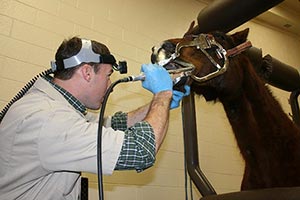
Why float teeth, ancient wild horses seem to have done fine without dentist?
Good point and I agree it seems ancient wild horses did great without rasping of their teeth. The horse has evolved to be a grass consuming machine. Through the course of millennia, they have developed long teeth that continue to erupt (grow) throughout life.
It is important to know that the horse evolved to graze and chew up to 16 hours daily on coarse, fibrous grasses. Modern domesticated horses may spend much of their time in stalls, eating concentrates and hay, chewing much less than those on pasture.
Modern domesticated horses with pasture access typically graze on manicured grasses that are comparatively delicate and lack the gritty silica content consumed by their ancestors and cause less tooth wear. Additionally, as a horse chews grain its lower jaw does not move side to side with the same amount of travel as when chewing grass.
This decrease in chewing motion results in much sharper points developing and at a quicker rate then in horses eating only grass.
Read more: Dental Basics: The Who, What, When, How and Why of Floating Teeth
by Margret Henkels
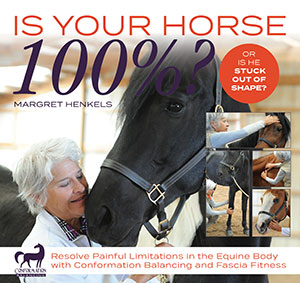
Clients often ask me how I got into horse myofascial bodywork. A passion for horses, and my own personal experience of being completely healed, brought me to this work—Conformation Balancing. A riding fall at 28 brought chronic injuries lasting years. I knew nothing about fascia (connective tissue) and its role in organizing the entire body. A synchronicity at a horse show introduced me to Steve Evans, a Heller Work practitioner. Heller Work is an offshoot of Rolfing and trains people in its particular approach to fascia. The weekly myofascial-release sessions transformed me into fitness. Each week, for 15 weeks, I drove to Taos where Steve lived and returned feeling better. I loved the changes I felt and the work itself. My experience is that Heller Work is much less strenuous tissue work and is comfortable for the patient, even in the first session, unlike Rolfing, which is known to be strenuous.
On his table, I talked about my horses often and told him stories of my rides. Steve suggested I consider getting into the horse bodywork field. “Just what I need, another startup,” I said with a laugh. His suggestion seed grew. The changes I felt transformed my goals. Paperwork and financial data of the business world lost their charm. I felt amazingly better and fit enough to work with horses. He referred me to Equine Natural Movement, Heller for Horses, in Battle Ground, Washington, where I took a module of training, before certifying.
In myofascial-release training, I heard the call of the physical world. And, I learned something completely new: how hidden feelings surface when myofascial cells open as they release compression, and in the process, release trauma that has been held in the body. The emotional and spiritual transformations that occurred during myofascial change fascinated me: this clearing of trauma by bodywork is part of the amazing miracle of myofascial change. In sessions with horses, I watched horses change emotionally and trust me. Horses in pain wanted help.
- The Effects of Routine Morning Exercise on Muscle Response
- Is the Great British Shire Horse About to Go Extinct?
- Red Light at Night Facilitates Recovery and Rest
- Breathing Easy: A Key to Equine Health and Performance
- Alfalfa and the Insulin Resistant Horse - The True Story
- Burning And Learning?
- The Canadian Horse: Discover a Versatile Breed Rich in History
- Core Equine Disease Risks Increase Amid Mosquito Season
- Equilume Stable Light Can Influence Body Composition and Biological Rhythms in Horses-in-training
- Inflammation: It’s Not Just In Joints
- Horsepower: How Digital Technology is Transforming the Equine World
- Exercising and Training Horses in Hot Weather
- Choose Hemp Instead of Soy for Your Horse!
- Equine Odontoclastic Tooth Resorption and Hypercementosis
- What is the Ideal Conditioning Program for an Eventer?
- Is Your Horse a Slave in a Sand Box?
- Surprise! It's Twins!
- Dental Surgery and Extractions
- A Rejected Foal and a Brokenhearted Mare Saved Each Other
- Miniature Horse Therapy: Great Big Good Things in Small Packages