




Health & Education
We all want the best care possible for our horses. The Heath & Education section covers both Learning Institutions, Organizations as well as many sources for equine assistance including Veterinarians and Farriers.
For those who want a to formally study horses, the Education section includes College Riding, Equine Studies, and Veterinary Schools. Learn about the wide variety of horses in the Horse Breeds section. Supplements and Treatments Therapy are also included in the section.
Everyone can learn from Fine Art and there are some specialty Museums that might surprise you.
Horses as a therapy partner enrich the lives of the disabled. These facilities are listed in our Therapeutic Riding section. To help children and young adults build confidence and grow emotionally, please see the resources available on the Youth Outreach page.
Looking for a place to keep your horse? You can find it in the Horse Boarding section. Traveling? Find a Shipping company or Horse Sitting service if your horse is staying home!
Want to stay up to date with the latest training clinics or professional conferences? Take a look at our Calendar of Events for Health & Education for the dates and locations of upcoming events.
Do we need to add more? Please use the useful feedback link and let us know!
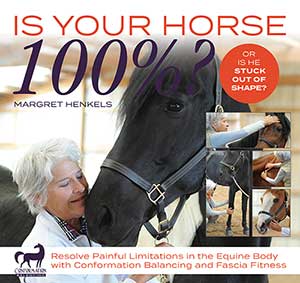
by Margret Henkels
The tail is a major part of the hindquarters puzzle. When you first handle it, the tail seems to have little muscle, yet it is essential to freedom of movement for the horse’s hindquarters. Tail releases for stiff tail vertebrae are wonderful paths to hindquarters progress. It’s a miraculous change for such a huge dense area of muscle through a small, easy-to-handle part of the horse. An expressive tail is easy to notice.
The tail is the horse’s coccyx. As you know, it’s a painful injury when you fall on your tailbone. The horse uses his tail to balance. The tail is kept fluid by movement. Wild horses move a distance of at least 50 miles a day over varied terrain. A much more “sedentary” lifestyle means the horse’s tail becomes less flexible: it loses articulation of the vertebrae.
Many tails are like broomsticks: they are stiff, unable to bend laterally, or curve upward. Very few tails are able to curl back to touch the croup, as they would if flexible. In most cases, the horse’s tail can bend laterally somewhat and, perhaps, curl halfway up toward his croup, but that is all he can allow. Many horses are concerned when you begin to handle their tail at all.
Complete release of the tail is vital to improving self-carriage and collection. You can’t spend too much time releasing a tail. Short opportunities bring good results, even when the horse snacks, or when we spend time companionably. The horse loves this kind of bodywork.
Read more: Improve the Horse’s Balance, Movement, and Self-Carriage with These Easy Tail Exercises
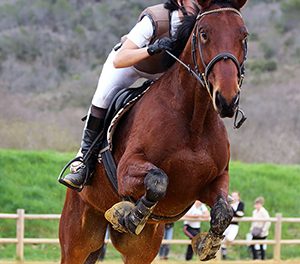
Understanding horse arthritis treatment and horse joint health
Thoroughbred mare, Tiz Cha Cha, never traveled balanced to the left. When she would collect in dressage or frame over a jump, she would become aggressive with ears pinned, relentlessly throw her head or rear up dangerously. Her behavior was chalked up to being a “hot” off-the-track Thoroughbred; however, a series of X-rays revealed what the human eye could not see -- a C1 fracture of the vertebrae, nearest the poll, causing her significant pain from bone-on-bone contact and arthritis.
What is equine osteoarthritis or degenerative joint disease?
Equine degenerative joint disease (DJD) is often referred to as equine osteoarthritis (OA). This chronic disease causes degeneration of the joints and results in pain, inflammation and reduced flexibility. Any joint in a horse’s body can be affected, and all horses regardless of age, breed or discipline can be impacted. It is estimated that OA is responsible for up to 60 percent of all lameness in horses.
Do different equine sports affect specific joints?
Although any horse in any discipline can be affected by OA, there are common themes and joint problems that occur in the varying equine sports. Such as for cutting and reining horses, who have greater impact on their hocks and stifles causing them to have heightened OA risk to these joints. Additionally, hunter jumpers are more likely to have front limb lameness in the coffin or fetlock joints. Any joint that is more significantly used on a horse increases its likelihood for developing OA.
- The Benefits of Riding to Music
- How to Feed a Severely Neglected Rescue Horse
- Josh Lyons with Lyons Legacy Partner With Horses in Need
- Equine Disaster Preparation and Response
- Colostrum -- An Exceptional Superfood!
- What the Heck is PEMF Anyway?
- Deworming Your Horse? Reference this Comprehensive Q&A
- Equine Enteric Coronavirus
- Is Your Horse Protected Against These Disease Risks?
- Equine-Facilitated Psychotherapy: Facing Trauma With a Horse by Their Sides
- University of Kentucky’s Department of Veterinary Science Responds to Nocardioform Placentitis
- Odd Couples
- Born to Stretch — Long and Low
- Don’t Be So Hard On Yourself; 10 Ways to Stay Positive About Showing
- 3 Tips for Horse Riding With Epilepsy (and Confidence)
- Physical Signs of Damage Caused by Ill-Fitting Saddles
- Conception Failure in Mares: Seven Causes
- Horses Blink Less, Twitch Eyelids More When Stressed, U of G Researchers Find
- Maintain Your Horse’s Safety This New Year's Eve
- Caring for “Winter Woolies”