





Health & Education
We all want the best care possible for our horses. The Heath & Education section covers both Learning Institutions, Organizations as well as many sources for equine assistance including Veterinarians and Farriers.
For those who want a to formally study horses, the Education section includes College Riding, Equine Studies, and Veterinary Schools. Learn about the wide variety of horses in the Horse Breeds section. Supplements and Treatments Therapy are also included in the section.
Everyone can learn from Fine Art and there are some specialty Museums that might surprise you.
Horses as a therapy partner enrich the lives of the disabled. These facilities are listed in our Therapeutic Riding section. To help children and young adults build confidence and grow emotionally, please see the resources available on the Youth Outreach page.
Looking for a place to keep your horse? You can find it in the Horse Boarding section. Traveling? Find a Shipping company or Horse Sitting service if your horse is staying home!
Want to stay up to date with the latest training clinics or professional conferences? Take a look at our Calendar of Events for Health & Education for the dates and locations of upcoming events.
Do we need to add more? Please use the useful feedback link and let us know!
In this episode of StallSide, we are joined by Dr. Andrew van Eps, originally from Australia, who is a leading researcher at the University of Pennsylvania specializing in equine laminitis. Dr. van Eps shares his groundbreaking findings and the latest advancements in understanding, preventing, and treating this debilitating condition focusing on cooling therapy. Discover insights and gain valuable practical knowledge from the van Eps Laminitis and Endocrinology Laboratory at New Bolton Center, which is dedicated to unraveling the critical events driving laminitis under different circumstances to develop reliable means of prevention and treatment.
Horse Miscarriages Offer Clues to Causes of Early Human Pregnancy Loss - Cornell Veterinary Medicine
A study of horses – which share many important similarities with humans in their chromosomes and pregnancies – revealed that 42% of miscarriages and spontaneous abortions in the first two months of pregnancy were due to complications from an extra set of chromosomes, a condition called triploidy.
“Over that embryonic period [up to eight weeks from conception], triploidy had rarely been reported in mammals outside of women,” said Mandi de Mestre, the Dorothy Havemeyer McConville Professor of Equine Medicine at Baker Institute for Animal Health and in the Department of Biomedical Sciences at the College of Veterinary Medicine. “The study tells us that over the first six weeks of gestation, this will likely be the primary cause of pregnancy loss following natural conception.”
De Mestre is the corresponding author of Naturally Occurring Horse Model of Miscarriage Reveals Temporal Relationship Between Chromosomal Aberration Type and Point of Lethality published August 5, 2024 in the Proceedings of the National Academy of Sciences.
Human miscarriages occur in 10-20% of pregnancies and are commonly associated with chromosomal errors, but there have been no suitable animal models that truly duplicate the features of the condition. The new research findings will help veterinarians better understand the causes of pregnancy loss in horses, and identifies horses as an excellent model for studying human miscarriage.
“We were able to study the impact of chromosome errors across the entire pregnancy in the horse,” de Mestre said. “We found that triploidy is only associated with losses in early pregnancy.”
In the study, de Mestre’s laboratory at Cornell, and earlier at The Royal Veterinary College, London, received 256 fetus and placenta samples from veterinarians who treated horses with failed pregnancies over a period of 10 years. Using the samples, the researchers were able to investigate the prevalence of different types of chromosomal copy number errors associated with pregnancy loss.
They found that chromosomal errors occurred in 57.9% of pregnancy losses up to day 55 of gestation, in 57.2% of losses between days 56 and 110 and in only 1.4% of losses between days 111 and the end of pregnancy.
Aneuploidy (loss or gain of a single whole chromosome) was mainly associated with miscarriages in the first 10 weeks of pregnancy, while deletions or duplications of only part of a chromosome were found in miscarriages after 110 days. These findings turned out to be remarkably similar to those observed in a number of large studies in women, according to the paper.
Horses are a good model for studying human pregnancies because they have a similar gestation period – 11 months compared to nine months in women – and the embryo develops at a similar rate in the early stages. In addition, horse chromosomes have a very similar genetic content to human chromosomes, which makes them particularly relevant for the study of chromosome errors.
Reasons for miscarriage in women in very early pregnancy have been difficult to determine because most fetuses during this period are lost at home, leaving scientists without material – and data – to study. The study’s findings provide insight into the frequency of chromosome errors over the equivalent period of the first six weeks of human gestation.
Because of the value of horses and the emotional attachment their owners have to them, horses receive a high level of care, with routine tracking of pregnancies, which then provide extensive data for research.
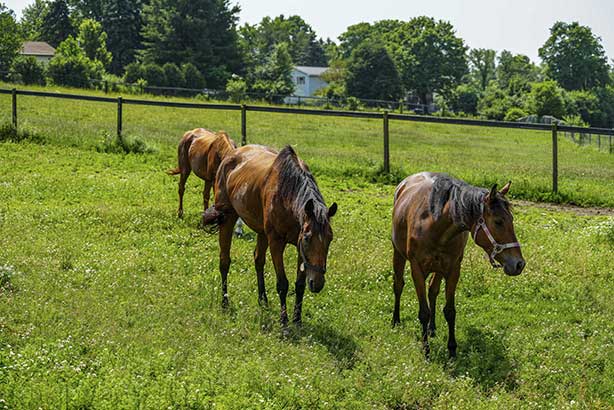
Photo courtesy of John Enright, Cornell College of Veterinary Medicine.
Other animal models, such as mice, are not comparable to human pregnancies. Mice have a gestation period of about three weeks, and natural pregnancy losses in mice are low.
In terms of equine health, the study provides new details about common chromosomal abnormalities that will likely change the clinical management of pregnancies.
For example, if a clinician determines that a horse has a major chromosomal error, they may no longer choose to extend that pregnancy by administering hormones, a common practice in pregnant mares. The study will also point researchers toward the development of new diagnostic tests for chromosome abnormalities in horse fetuses and investigating molecular mechanisms that lead to these abnormalities.
“This research has provided a foundation for understanding the genetic causes of pregnancy loss in horses, often referred to as pregnancy loss of unknown cause,” said Shebl Salem, a postdoctoral researcher in de Mestre’s Equine Pregnancy Lab and a co-first author of the study.
Other co-first authors include Jessica Lawson of the Royal Veterinary College in London, United Kingdom; and Donald Miller, de Mestre lab manager.
The study was partly funded by the Horserace Betting Levy Board and Thoroughbred Breeders Association.
This article originally appeared on the Cornell University "Cornell Chronicle" and is published here with permission.
The are more informative educational articles in our section on Health & Education.
- A 6-Step Guide to Keeping Your Horse Healthy
- Performing Treadmill Endoscopy at Rood & Riddle Equine Hospital (1:59)
- Rood & Riddle Stallside Podcast - Tall Fescue Woes: Insights on Endophyte Ingestion
- Rood & Riddle Stallside - Understanding Equine Biomechanics and Farriery with Dr Jenny Hagen
- Regenerative Medicine Therapies in Horses
- Educational Benefits of Equine-Assisted Learning Programs for Students
- Why is the Mule the Most Important Member of the Horse Family? Cornell Equine Seminar
- Five Tips for Keeping Your Horse Sound - Cornell Vet Equine Seminar Series
- Deworming the horse using a paste syringe with Teresa Kackert
- Stable Vices: Theirs or Ours? Abnormal Behavior in Horses
- FAQ: Lameness and Arthritis in Horses
- How to Safely Pony a Horse with Teresa Kackart (6:55) - Certified Horsemanship Association
- Equine Emergencies 101: What To Do When the Worst Happens from Cornell Equine Seminar
- Pre-purchase Headaches in the Sport Horse
- Sources of Magnesium - Including Whole Foods
- The Grayson-Jockey Club Research Foundation: Improving the Ability to Diagnose Spinal Cord Diseases
- Leadership Isn’t as Simple as it Sounds - an Excerpt from "How Two Minds Meet"
- CBD and other Cannabinoids – How they can benefit you, your horses, and your pets
- Foal Handling with Monty Roberts (2:00)
- Rood & Riddle Stallside Podcast: Sport Horse Medicine & Innovative Therapies with Dr Daniel Devis