




Health & Education
We all want the best care possible for our horses. The Heath & Education section covers both Learning Institutions, Organizations as well as many sources for equine assistance including Veterinarians and Farriers.
For those who want a to formally study horses, the Education section includes College Riding, Equine Studies, and Veterinary Schools. Learn about the wide variety of horses in the Horse Breeds section. Supplements and Treatments Therapy are also included in the section.
Everyone can learn from Fine Art and there are some specialty Museums that might surprise you.
Horses as a therapy partner enrich the lives of the disabled. These facilities are listed in our Therapeutic Riding section. To help children and young adults build confidence and grow emotionally, please see the resources available on the Youth Outreach page.
Looking for a place to keep your horse? You can find it in the Horse Boarding section. Traveling? Find a Shipping company or Horse Sitting service if your horse is staying home!
Want to stay up to date with the latest training clinics or professional conferences? Take a look at our Calendar of Events for Health & Education for the dates and locations of upcoming events.
Do we need to add more? Please use the useful feedback link and let us know!
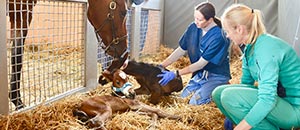
by Sacha Adorno
Excitement over a first pregnancy turned to concern for owner Adel Dukes Melson when her pregnant Holsteiner began showing signs of premature foaling. Weeks before the mare’s March 13 due date, her mammary gland started to develop and secrete milk, a typical indication that her body was preparing to soon give birth.
On February 19, Owner and horse traveled two hours from their home in Bethany Beach, Delaware to Kennett Square, arriving at New Bolton Center’s Emergency & Critical Care department at 8:30 PM.
There, they met Dr. Michelle Linton, Staff Veterinarian, Neonatal Intensive Care specialist, and part of Penn Vet’s High Risk and Healthy Mare Foaling programs.
That night, Linton and her team performed a physical exam, transrectal ultrasound, and fetal heart rate test. The next morning Treasure received an abdominal ultrasound to assess the fetus, uterus, and placenta.
Linton was expecting to find placentitis, the most common reason for premature mammary gland development and a potentially life-threatening condition for mare and foals.
“Treasure came in as a likely placentitis case, and we treated her as one,” Linton said. “But her uteroplacental measurements were normal, suggesting we were maybe dealing with something more.”
Although the ultrasounds showed one fetus and one heartbeat, Linton suspected Treasure might be carrying twins, which could also explain early udder development – and which, surprisingly, can be easy to miss in prenatal exams. She admitted the mare — 317 days pregnant at this point — to the Neonatal Intensive Care Unit (NICU) for monitoring and rest. Over the next few weeks, Treasure grew bigger and bigger but didn’t go into labor.
Four Legs... Then Four More
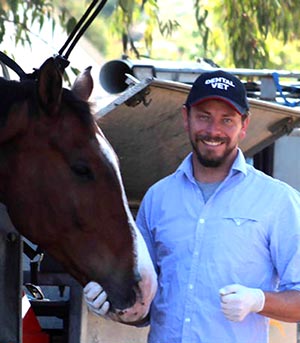
by Dr Shannon Lee BVSc, MANZCVSc Eq Dent, DICEVO
As dental surgery becomes more complicated, so too do the headaches.
For many horse owners, dentistry and dental complaints aren’t something that’s front of mind. After all, their horse looks fine, eats okay and can be ridden.
Furthermore, the assumption is often that, if there was a problem, it would be new, easily identified and quickly fixed, so things could go back to the way they had always been… Right? Wrong!
Fundamentally, this attitude simply derives from a lack of understanding. More often than not, it is also one of the reasons why if a serious issue is discovered in your horse’s mouth necessitating surgery, it may be far more challenging than you might expect. Therefore, delaying diagnosis and early treatment may be both costly and reduce the likelihood of an ideal outcome.
In plain English, this means getting the right advice as early as possible gives you and your horse the best chance of getting things back on track.
Two of the most common comments made by horse owners as they gain a better understanding of equine dental care are:
“I didn’t realise horses’ teeth went so far back!” and “I had no idea their teeth were so big!”
Contrast this with the fact that many horse owners still think tooth removal is a matter of simply ‘pulling’ a tooth; resulting in a huge gap between what’s actually required and many people’s understanding of what’s really involved - pun intended.
Surgery is surgery and so, the two main aims of any surgery will be to opt for the option that provides the best chance of success with the least chance of complication or risk. As surgeries become more challenging (read complicated), they increase the chances of a complication. For this reason, when dealing with dental surgeries, it is usually best to begin with the simplest approach and go from there.
- A Rejected Foal and a Brokenhearted Mare Saved Each Other
- Miniature Horse Therapy: Great Big Good Things in Small Packages
- Man O’ War Project Helping the Soldiers of War Heal
- Is Icing Still a Valid Treatment for Injuries?
- Must-Have Secret Training Tools
- My Daughter is My Hero
- Horse Training: 7 Essential Steps for Safely Handling Your Horse's Feet
- Kinesiology Taping for Horses—It’s a Thing!
- AVMA Proposes Elimination Of Farrier Exemption From Veterinary Practice Act
- The Keys to Building Confidence in Your Horse from a Master Liberty Trainer
- What is a Shagya-Arabian?
- New Year’s Resolutions for the Senior Horse Owner
- Understanding Cold-Induced Laminitis
- Keeping Your Horse Calm Naturally During Stall Rest
- How “Let’s Do It!” Can Change Your Horse Business…and Your Horse
- Dr. David Nash and NSF Grant Moves Equine Medicine into the Future, with Wide-Ranging Visions for Human Use, as Well
- Fall Equine Wellness: What Your Horse Needs
- The Effect of Minerals on the Insulin Resistance (IR) Horse
- Hurricane Harvey and Irma Horse Rescues
- Texas’ Horseback Emergency Response Team: Helping Hands and Horse, in the (Literal) Trenches