




Health & Education
We all want the best care possible for our horses. The Heath & Education section covers both Learning Institutions, Organizations as well as many sources for equine assistance including Veterinarians and Farriers.
For those who want a to formally study horses, the Education section includes College Riding, Equine Studies, and Veterinary Schools. Learn about the wide variety of horses in the Horse Breeds section. Supplements and Treatments Therapy are also included in the section.
Everyone can learn from Fine Art and there are some specialty Museums that might surprise you.
Horses as a therapy partner enrich the lives of the disabled. These facilities are listed in our Therapeutic Riding section. To help children and young adults build confidence and grow emotionally, please see the resources available on the Youth Outreach page.
Looking for a place to keep your horse? You can find it in the Horse Boarding section. Traveling? Find a Shipping company or Horse Sitting service if your horse is staying home!
Want to stay up to date with the latest training clinics or professional conferences? Take a look at our Calendar of Events for Health & Education for the dates and locations of upcoming events.
Do we need to add more? Please use the useful feedback link and let us know!
-001.jpg)
by Bob Burdekin
As I started to work with horses that had a large amount of stress that had been retained within their bodies I started to realize that there were other controlling factors that needed to be considered and addressed.
This is where the factor of PTSD (Post-traumatic Stress Syndrome) was first considered and researched; before I could start to help a horse that might be suffering from PTSD I had to understand what PTSD was, what caused it to occur and look at where it might have come from.
Upon seeing some of the basic research that had been done with people I did realize that it was based within the workings of the brain and certain aspects or even a specific occurrence in an individual's life opened the door to PTSD. It was at this point that in order to fully understand how it might affect the horse I felt that I needed to look to a comparison between the human brain and the brain of the horse.
What I found in that comparison was quite amazing; what I learned showed me that both brains are just a similar as they are different.
Initially, I discovered that the brain of the horse has an average size similar to a large grapefruit; while the human brain occupies most of the space that is available within the human skull. The next point of interest that was discovered was that any species ability to think through any specific problem (their cognitive skills) is directly related to the ratio of the size of the brain to the size of the body that it is contained within.
The human brain is close to 1/50th of the total body weight and size, where the brain of the horse is 1/650th of their body size and weight.
The next logical step was to look to how the brain of the horse functioned and it was here that I discovered how and why horses think and respond the way that they do. Let's start at the very beginning when a horse is born that have to have to be equipped to survive from the moment they are born, I have heard this referred to as "ready for life".
What I understand that to mean is that new-born foals are up on their feet and totally operational within the first hour of their life. Consequently, at this point in their life, all of their actions are controlled by their "brain stem", which is an integrated part of their "reptilian" part of their brain. This becomes very important since it is the reptilian part of the brain that becomes the storehouse for additional information as the foal grows and progresses.
It is during this time of development that the main areas of importance are the aspects of controlling balance along with developing better use of both eye and head movements.
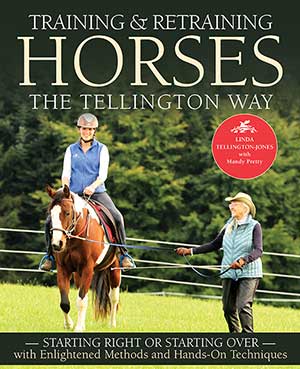
by Linda Tellington-Jones
Before starting any exercise, take the time to connect and listen to your horse with your hands. You can easily do this by mindfully running your hands all over your horse’s body. This simple Body Exploration exercise will provide you with valuable information regarding your horse’s state of body and mind as well as his level of trust in you as a handler.
A horse that is very comfortable being touched all over his body will be better prepared for any experience under saddle than one that is defensive, ticklish, or tense.
Having a horse that is truly happy and comfortable about being touched is incredibly important. Not only does this signify relaxation and physical well-being, it also tells you a lot about how much he trusts you. This is also very significant for horses that are already trained but may be having specific issues under saddle.
Going back to the basics and helping your horse become comfortable about being touched everywhere will often help seemingly unrelated training issues.
For instance, if your horse has a tight, clamped tail, you will often find that this same horse may be nervous about noises or movement behind him.
How to Use It
Begin by checking the horse’s body with your flat hand. It is helpful to have someone holding your horse, or you can work freely in a stall-sized area, rather than having him tied up, so you can observe his reactions. Stroke the horse on the shoulder before beginning your Body Exploration to prepare him so he does not respond just because he was surprised.
For some very sensitive horses the flat of the hand may be too much. If this seems to be the case, try using the back of your hand.
Starting at the poll, right behind the ears, let your hands slide over the strong neck muscle, paying close attention along the way. Your hands are feeling for slight irregularities: swellings, change in temperature, quality of the tissue, hard muscles, twitching, knots, change in the hair, scars, or areas where the horse is uncomfortable being touched.
It is best to start with a light pressure, which you can adjust if the sensitivity or reaction of the horse requires you to do so. Sometimes horses are surprised by the touch of the fingertips; therefore, it is important to check if it was a startle reflex, or the horse reacting because he is tight.
A healthy horse that is not tense will usually show a light response to a light pressure. When going over the poll and neck this horse will lower his neck, while a horse that is tight will raise his head and possibly show pain or fear.
Read more: Is Your Horse Happy and Comfortable? Find Out with This Simple Body Exploration
- Appaloosa - The Most Beautiful Horse Breed in the World
- Stress and Your Horse's Brain
- Horse Training Power Tip: Loading Difficult Horses Into Trailers
- Electrolyte Problems in Endurance Horses
- U.S. Rep. Steve Cohen Ushers Horse Transportation Safety Act to Passage
- A Vet’s Guidance for Saving Horses in Need, Plus Training Your Eye to Nail the Distance
- Grazing the Metabolic Horse
- Disaster Preparedness
- Need Help Reopening Your Equine Business Amidst Covid-19? Barton Rodgers TempDefend™ Sensor Solution is Your Answer!
- Why I Did the Mustang Makeover—and Why I’d Do It Again
- Improve the Horse’s Balance, Movement, and Self-Carriage with These Easy Tail Exercises
- Q&A: Managing Arthritis in Horses
- The Benefits of Riding to Music
- How to Feed a Severely Neglected Rescue Horse
- Josh Lyons with Lyons Legacy Partner With Horses in Need
- Equine Disaster Preparation and Response
- Colostrum -- An Exceptional Superfood!
- What the Heck is PEMF Anyway?
- Deworming Your Horse? Reference this Comprehensive Q&A
- Equine Enteric Coronavirus