




Health & Education
We all want the best care possible for our horses. The Heath & Education section covers both Learning Institutions, Organizations as well as many sources for equine assistance including Veterinarians and Farriers.
For those who want a to formally study horses, the Education section includes College Riding, Equine Studies, and Veterinary Schools. Learn about the wide variety of horses in the Horse Breeds section. Supplements and Treatments Therapy are also included in the section.
Everyone can learn from Fine Art and there are some specialty Museums that might surprise you.
Horses as a therapy partner enrich the lives of the disabled. These facilities are listed in our Therapeutic Riding section. To help children and young adults build confidence and grow emotionally, please see the resources available on the Youth Outreach page.
Looking for a place to keep your horse? You can find it in the Horse Boarding section. Traveling? Find a Shipping company or Horse Sitting service if your horse is staying home!
Want to stay up to date with the latest training clinics or professional conferences? Take a look at our Calendar of Events for Health & Education for the dates and locations of upcoming events.
Do we need to add more? Please use the useful feedback link and let us know!
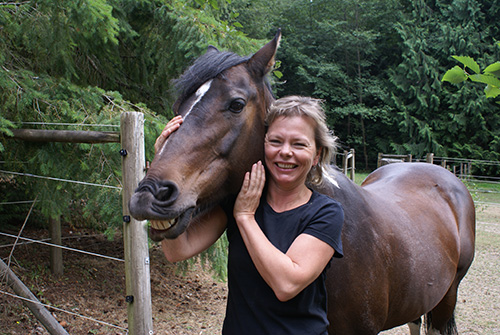
Carole Herder, President of Cavallo Horse & Rider, shares her thoughts.
Q: Carole, you often talk about leaning on your horses during times of stress. The constant news about COVID has me worried and downright fatigued. What’s the best way that you have found for horses to help during this ongoing pandemic?
A: Horses provide a quiet connection to nature and help us all connect and quiet our minds. We live in the country and enjoy a rural setting. We all have our animals to keep us from feeling too much isolation.
They are often the best companions anyway. During this time of pandemic, people are out riding their horses, and they are calling us for advice about how to keep their horses moving and feeling great.
Pandemic Panic
Unfortunately, not everyone is doing as well. For example, my neighbor is negatively affected by this pandemic. By the news, the fear, and the anxiety around COVID. She's not alone. Constantly judging the correct distancing and checking to see whether people are wearing masks has many people upset.
These folks are placing their frame-of-reference on the external forces around them and forgetting to nurture their own internal states. They're letting the news run the show. My friend has a hard time looking inward and is continuously being distracted by the media.
She lost her horses last year, and I now see how important they were to her happiness. They helped her focus, be quiet and connect with nature. That's what horses do.
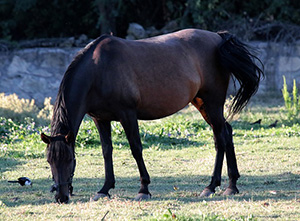
The pregnant mare has the same basic needs for water, nutrients and exercise, but with different targets.
The calories are the easy part. If you have a good quality hay (DE at least 0.9 Mcal/lb on hay analysis) she will need to eat only about 19 lb of hay/day in her 5th month, up to 24 lbs in the last month if her prepregnancy weight was 1100 lbs - and proportionately less or more if she is below or above that weight. This is definitely a reasonable consumption. If she won't eat that much, supplement her with a balanced commercial feed at the rate of 1 lb of feed for every 2.5 lbs of hay below her target intake.
Protein may be more problematic. She can still meet protein needs if the hay is at least 11% protein. This is possible but by no means guaranteed. If your hay is 8% protein instead of 11%, it is lacking 14 grams of protein per pound. For 20 lbs of hay that's about 280 g of protein.
If you are feeding grain instead of hay for part of the ration, there is also a protein deficiency. One pound of grain = approximately the calories of 2.5 pounds of hay. If the grain is 14% protein it supplies 64 g of protein. Even an 8% protein hay yields 91 g of protein in 2.5 pounds and at 11% it is 125 g compared to the 64 g in the grain.
The body makes proteins by stringing together amino acids. Essential amino acids are those that need to be adequate in the diet because the horse cannot make them. Lysine is the most important in pregnancy and supplementing at least 10 g/day is advisable, either as part of a protein supplement or separately if not supplementing protein.
- Equestrian Diversity Project Spotlight: Ebony Horsewomen
- Equine Guelph at the University of Guelph in Canada presents "Journey of the Digestive Tract"
- Tennessee Walking Horse Protection - Effort to End Abusive Practice of ‘Soring’
- Air Quality in the Barn - That Cozy Barn May Not Be Best for Lung Health
- Practice Preparedness and Prevention - Resources on Barn Fire Prevention
- Fecal Transplants for Animals
- I Have the Wrong Horse: Now What?
- Gratitude & Horses: Healing the Cracked Places
- From the Research Farm to Your Feed Room: Applying Study Results to Improve KER EO-3
- Neuromuscular Support Nutrients
- The Roadmap to PTSD in Horses
- Is Your Horse Happy and Comfortable? Find Out with This Simple Body Exploration
- Appaloosa - The Most Beautiful Horse Breed in the World
- Stress and Your Horse's Brain
- Horse Training Power Tip: Loading Difficult Horses Into Trailers
- Electrolyte Problems in Endurance Horses
- U.S. Rep. Steve Cohen Ushers Horse Transportation Safety Act to Passage
- A Vet’s Guidance for Saving Horses in Need, Plus Training Your Eye to Nail the Distance
- Grazing the Metabolic Horse
- Disaster Preparedness