




Health & Education
We all want the best care possible for our horses. The Heath & Education section covers both Learning Institutions, Organizations as well as many sources for equine assistance including Veterinarians and Farriers.
For those who want a to formally study horses, the Education section includes College Riding, Equine Studies, and Veterinary Schools. Learn about the wide variety of horses in the Horse Breeds section. Supplements and Treatments Therapy are also included in the section.
Everyone can learn from Fine Art and there are some specialty Museums that might surprise you.
Horses as a therapy partner enrich the lives of the disabled. These facilities are listed in our Therapeutic Riding section. To help children and young adults build confidence and grow emotionally, please see the resources available on the Youth Outreach page.
Looking for a place to keep your horse? You can find it in the Horse Boarding section. Traveling? Find a Shipping company or Horse Sitting service if your horse is staying home!
Want to stay up to date with the latest training clinics or professional conferences? Take a look at our Calendar of Events for Health & Education for the dates and locations of upcoming events.
Do we need to add more? Please use the useful feedback link and let us know!
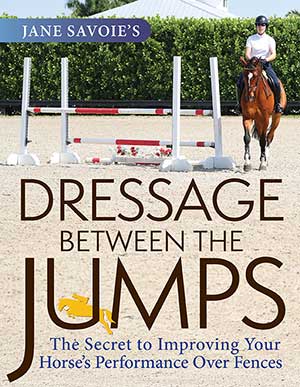
By Jane Savoie
Connection means that you’ve connected your horse’s back end to his front end. Think of your horse’s back like it is a suspension bridge or a strung bow. If your horse’s neck is round, but he doesn’t touch the reins (there are loops and a lack of contact), he’s “behind the bit.” Some horses even look like they have what’s called a “broken neck.” This expression refers to the fact that the highest point of the neck is at the third vertebra rather than the horse’s poll.
Draw reins and other gadgets won’t help your horse understand how to come honestly on the bit—instead, he’ll often adopt this “behind the bit” position. Gadgets create a false frame so there’s no real connection. “Fiddling” with the bit or “sawing” on your horse’s mouth gives you the same false headset. Rather than going through them, he “sucks back” away from them, or breaks at the third vertebra.
When your horse consistently goes behind the bit, show him how to take a contact with your hands by teaching him to go “forward through his body.” Let me elaborate on the word “forward” first.
There are different aspects to being “forward.” Forward is a direction. For example, your horse can travel straight forward over the ground. He can also travel sideways and forward, like in a leg-yield. You also want your horse to “think forward.” This means he takes responsibility for his own energy, and he’s also reactive to your driving aids.
When your horse is either behind the vertical or behind the bit, he needs to go forward through his body. Think of his body as a parallelogram. If his profile is behind the vertical, his hind legs are out behind his body to the same degree. You need to shift the parallelogram in the opposite direction so the hind legs come under the body and the poll comes up.
To teach him to go forward through his body so you shift the parallelogram, do this exercise:
1. Go on a circle in posting trot.
2. Close your legs to ask for a few strides of a lengthening.
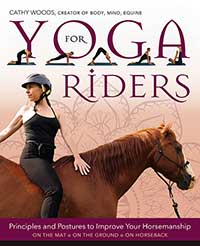
An excerpt from Yoga for Riders: Principles and Postures to Improve Your Horsemanship by Cathy Woods.
When going for a walk or jog, some of us innately feel what gait, swing, and motion is optimal. If we’re paying attention, we know what feels smooth and uses the least amount of energy yet works our muscles in a safe, effective way.
However, others of us have not learned proper alignment, or we have developed bad habits around our posture and movement. The physical aspect of yoga is a practice that helps us improve in these areas so we move better, become less sore, and avoid injury.
Yoga also means spending integrated (and preferably uninterrupted) time with yourself, for the purpose of refining your body and mind. The yoga mat and meditation cushion are ideal places to come to know yourself better—a place for personal "groundwork" and "collection," so to speak.
After I’ve spent time on the mat doing yoga postures, I am more keenly aware of my body. My muscles feel engaged, and I’m more cognizant of how to properly use them. The residual effects linger throughout the day.
This translates into a more efficient use of my body during all my other activities—for example, when lifting a hay bale, I engage my legs more to keep strain off my back, and I am careful to grasp and lift the bale evenly, so I don’t risk straining a shoulder.
- Here Comes The Sun ~ But It’s Not Good For Everyone
- New Rotavirus Revealed with Dr Emma Adam (43:34)
- Any Horse in Regular Work is a Performance Horse
- Lose Your Fear of Selenium
- UC Davis-led Study Investigates Distribution of the Warmblood Fragile Foal Syndrome Allele in Multiple Breeds
- Veterinarians are Considering Lecithin for Treating and Preventing Ulcers
- Tetanus: Your Horse’s Risk May Be Greater Than You Think
- Pitfalls of Fecal Checks for Parasites
- Cavallo Q&A: Horse Time for Healing
- The Last Half of Pregnancy
- Equestrian Diversity Project Spotlight: Ebony Horsewomen
- Equine Guelph at the University of Guelph in Canada presents "Journey of the Digestive Tract"
- Tennessee Walking Horse Protection - Effort to End Abusive Practice of ‘Soring’
- Air Quality in the Barn - That Cozy Barn May Not Be Best for Lung Health
- Practice Preparedness and Prevention - Resources on Barn Fire Prevention
- Fecal Transplants for Animals
- I Have the Wrong Horse: Now What?
- Gratitude & Horses: Healing the Cracked Places
- From the Research Farm to Your Feed Room: Applying Study Results to Improve KER EO-3
- Neuromuscular Support Nutrients