




Health & Education
We all want the best care possible for our horses. The Heath & Education section covers both Learning Institutions, Organizations as well as many sources for equine assistance including Veterinarians and Farriers.
For those who want a to formally study horses, the Education section includes College Riding, Equine Studies, and Veterinary Schools. Learn about the wide variety of horses in the Horse Breeds section. Supplements and Treatments Therapy are also included in the section.
Everyone can learn from Fine Art and there are some specialty Museums that might surprise you.
Horses as a therapy partner enrich the lives of the disabled. These facilities are listed in our Therapeutic Riding section. To help children and young adults build confidence and grow emotionally, please see the resources available on the Youth Outreach page.
Looking for a place to keep your horse? You can find it in the Horse Boarding section. Traveling? Find a Shipping company or Horse Sitting service if your horse is staying home!
Want to stay up to date with the latest training clinics or professional conferences? Take a look at our Calendar of Events for Health & Education for the dates and locations of upcoming events.
Do we need to add more? Please use the useful feedback link and let us know!

The following is an excerpt from How Two Minds Meet: The Mental Dynamics of Dressage by Beth Baumert.
Horses are herd animals, and when it comes to riding horses, the importance of this fact is often overlooked and underestimated. All successful horse and rider partnerships are based on understanding the herd mentality.
By instinct, horses are “fight-or-flight” creatures, so they need a responsible leader to protect them in the face of threats. That’s how horses are in the wild, and those inclinations are still with horses that have been domesticated. They still need a leader and they will either fight or run away in the face of danger. Although your horse may come to trust you as his leader, it will serve you well to keep his innate needs in mind.
Emotionally, horses are as innately as different as people are, or as dogs are. Some are friendly, self-assured, and trusting like a Labrador; some are scrappy like a Jack Russell Terrier; others are insecure and unreasonably fearful. But unlike dogs who love you no matter what, horses require that you earn their affection.
When horses are wronged, they certainly don’t come back for more like dogs often do. They’re closer to cats on the spectrum of showing positive emotion. They might, in fact, feel love, but they don’t express it like dogs. Horses are matter of fact when it comes to what they like and what they don’t like. They’re more apt to show their fear than their positive responses. As a trainer working on gaining their trust, you try to reverse this trend. In the face of a fearful situation, a trained horse ideally turns to his rider for direction.
Being the leader isn’t always as simple as it sounds. Some horses wander aimlessly and don’t act as if they want to follow you. Others are pushy, and don’t appear to see you as the leader, either: they invade your space and don’t seem to want to be a follower. A horse might not be safe and trustworthy; you need to find a way for him to accept your leadership so you can trust him. Trust has to go both ways.
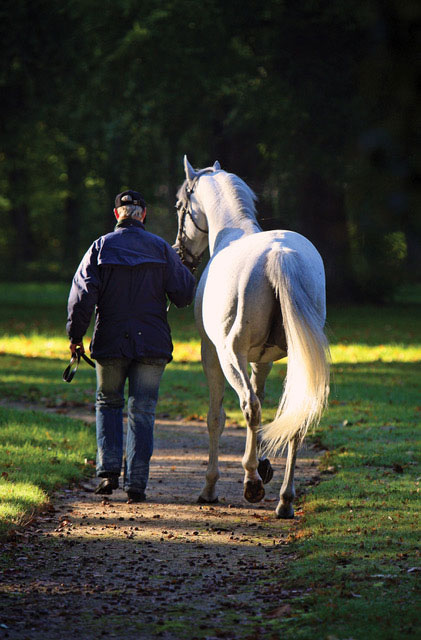
There are many different exercises and tasks that you can do to establish trust, like teaching your horse to respect your space, playing games together, being clear with your aids, and being trustworthy yourself.
The Limits of Leadership
When a new mare came into my daughter Jennifer Baumert’s life, she was eager to listen to everything the horse had to say. She wanted to get to know the new mare, so her first time in the saddle, she asked lots of questions: “How are you? How do you feel today? What’s your opinion of this and that?” The first day went well. Despite some basic connection issues, Jennifer felt she had a great rapport with the mare. The next day, Jennifer was armed with an agenda that she felt was a positive and appropriate plan. But the mare could feel Jennifer’s determination and felt threatened. In the past, other riders hadn’t been very kind and fair leaders, so the mare was immediately concerned about her rider’s position as leader. Jennifer was surprised that the mare suddenly became defensive.
Individual horses determine the limits to your leadership, especially when it comes to mares and ponies. There is a saying, “You ask a stallion, tell a gelding, negotiate with a mare, and pray with a pony.” Some might say you submit a 10-page request form to a mare! The bottom line is that all horses are different. When, over time, Jennifer’s mare grew to trust her, she was a very willing partner, but Jennifer always respected her leadership limitations—always made small talk during the warmup to check on the mare’s basic comforts.
Mares have a reputation for being opinionated because they have a keen sense of fairness. Ones with a history of less than ideal riding are particularly guarded. It isn’t simply about gender and temperament, but about history and whether the horse is trusting or not.
Fairness and Consistency are the Keys to Trust
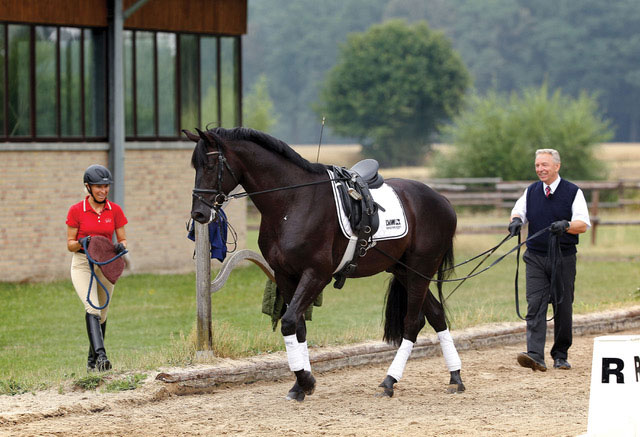
To be seen as trustworthy, you need to be consistent, clear, kind, and fair. This doesn’t mean you spoil your horse. Consistency and clarity require the physical skill and ability to follow the horse precisely, then to give exactly the same aids for the same request every time. This helps the horse better understand what, exactly, you are asking. This is important in all aspects of horsemanship, whether you are working with your horse on the ground or under saddle.
How Two Minds Meet: The Mental Dynamics of Dressage
BUY NOW on Amazon
Paperback | Kindle
This excerpt from How Two Minds Meet: The Mental Dynamics of Dressage is reprinted with permission from Trafalgar Square Books. Visit them online at Horse & Rider Books. All photos courtesy of Horse & Rider Books.
There a more really interesting books on riding and all aspects of equestrian living in our section on Books.
By Juliet M. Getty, Ph.D.
CBD’s popularity has mellowed over the years, but instead of fading into the background, researchers continue to expand and confirm its benefits. Most people think it is just one more supplement touted to relieve aggravating symptoms, but did you know that it is naturally occurring in our bodies as part of our endocannabinoid systems? Boosting levels that diminish due to age, stress, and illness can impact our body’s ability to heal itself.
I have written about CBD in an earlier article[i] where I explained how CBD can promote health for us as well as our horses. The goal of this article, however, is to expound upon the advantages of CBD and other cannabinoids and share with you what’s been recently discovered.
Review of the Endocannabinoid system
The endocannabinoid system (ECS) is a major signaling system that exists in you and your animals. It continually monitors any instability within the body and returns it to a state of balance or homeostasis so that the internal environment remains settled.
CBD (short for cannabidiol) and other cannabinoids are compounds that activate the receptors within this system. Cannabinoids, both naturally produced by the body (endogenous), and those supplemented from cannabis (exogenous), act as “keys” to these receptors, turning on a variety of health-promoting functions.
Within the ECS there are two main receptors -- CB1 and CB2:
- CB1 receptors exist mainly in the brain and central nervous system. They impact areas such as appetite regulation, memory, emotions, and feelings of pain.
- CB2 receptors are concentrated in the gastrointestinal tract and peripheral nervous system (nerve cells outside the brain and spinal cord) and modulate immune cell functions. When activated, they help reduce inflammation.
CBD does not make you “high”
CBD and THC (tetrahydrocannabinol) are the most studied, but they are only two, out of more than 80 different cannabinoids found in the cannabis plant. THC is intoxicating, and this is where many misunderstandings occur.
Hemp-derived CBD is not marijuana
Though both hemp and marijuana belong to the Cannabis genus, their genetic composition distinguishes them to produce vastly different amounts of THC. Hemp-derived CBD is high in CBD and very low in THC (less than 0.3%).
Hemp seed oil is not the same as CBD
It is important to understand that CBD only comes from the stalks, leaves and flowers of the hemp plant. The seeds, however, do not contain any CBD. Products just from the seeds such as hemp seed hearts, hemp seed pellets, hemp seed meal, hemp seed protein, or hemp seed oil, do not contain CBD. These hemp products offer quality nutrients and are highly beneficial for you and your animals.[ii]
If you want CBD, however, you should obtain a supplement[iii] that is third-party tested to ensure quality and consistency. You can download a CBD guide at CBDistillery’s website[iv].
How can CBD help you?
There are so many reasons to incorporate CBD and other cannabinoids into your routine. Here are a few conditions that are benefitted:
- Insomnia
- Anxiety
- Stress
- Post-traumatic stress disorder
- Pain and inflammation from injury
- Chronic pain[v]
- Cancer management[vi]
- Metabolic disorders
Understanding the CBD lingo[vii]
There are three types of CBD:
- Full-Spectrum CBD products. These contain naturally occurring cannabinoids such as CBN, CBG, and CBC, as well as terpenes and nutritious flavonoids. They do contain a tiny amount of THC, but it is quite small (less than 0.3%). All these compounds work together to provide a synergistic, “entourage” effect which multiplies their benefit. Full-spectrum CBD products are legal throughout the U.S. as long as the THC content does not exceed 0.3%. But each state has its own laws. The inclusion of a little THC enhances the efficacy in relieving symptoms.
- Broad-Spectrum CBD products. These start with full-spectrum extract and process it further to remove THC, resulting in a product with no THC (or no more than a trace -- less than 0.01%). Even so, they offer the entourage effect benefit because the terpenes and flavonoids are still present.
- CBD Isolate. This the purest form of CBD. Since it does not contain other cannabinoids, terpenes, or flavonoids, it is generally not as effective in alleviating symptoms. But it is a good choice in situations where testing is required (such as employment drug tests).
Read more: CBD and other Cannabinoids – How they can benefit you, your horses, and your pets
- Foal Handling with Monty Roberts (2:00)
- Rood & Riddle Stallside Podcast: Sport Horse Medicine & Innovative Therapies with Dr Daniel Devis
- Melatonin: Can It Predict Your Horse’s Temperament?
- Summer Safety: Barn Fans & Automatic Horse Waterers
- Upper Airway Obstruction in Barrel Racing Horses
- Start Horseback Riding off on the Right Hoof
- Highlining with Fred Bruce and Stan Loewen
- Double Lunging the Horse with Mitzi Summers (10:53)
- Music Helps Horses Better Respond to Performance Demands
- What to Expect When Sedating a Horse
- Benefits of Beet Pulp for Horses
- Monty Roberts - Cinder Part 2 The Value of Force Free Training (2:19)
- Monty Roberts - Cinder Part 1: Join Up with a Wild Horse (2:04)
- Inside the In Vitro Fertilization Lab at Rood & Riddle with Dr Charlie Scoggin & Dr Maria Schnobrich (37:25)
- The Making of a Dressage Trainer
- Topline Loss - How Nutrition Can Help
- New Tool Recognizes Pain in Horses with Osteoarthritis
- My Horse is Gaining Weight on Free-Choice Forage! Why Isn't it Working?
- 6 Must-haves For Your Next Horse Show
- Inside the Recipient Mare Herd from the Rood & Riddle Reproduction Center with Crystal Howard" (24:28)